

A rugged drive is not really about the drive. It is about the four hours of light you will never get back, the interview the subject will not sit for twice, and the wedding that happened once. The IP rating on the box is the price of not having that conversation.
What changed in 2026 is the maths behind it. Portable SSD prices have roughly tripled since 2023, so the drive you are protecting now costs three times what it did, and the thing in your camera bag is closer in value to a lens than to a memory card. A rubberised shell used to be a nice extra. At current prices it is an insurance decision.
This guide scores five 4TB drives on how well they survive being carried, not on how fast they benchmark on a desk. That distinction matters more than it used to, because the newest and most expensive drives on the market right now are, by the manufacturers' own published specifications, some of the least protected.

The Short Version
- Best rugged 4TB drive overall: the LaCie Rugged SSD Pro5. The only drive here sealed to IP68, and the only one rated to survive a two-tonne vehicle. From £1,199.
- Best value by a distance: the SanDisk Extreme PRO with USB4. IP65 sealing and 3GB/s speeds from £493.54, roughly £123 per terabyte against £300 for the LaCie. It settles for a 2 metre drop rating rather than 3.
- The newest drives are not the toughest. Samsung's P9 and P7 publish a 2 metre drop test and no IP rating at all.
- The P9 costs the same as the Pro5. £1,184.49 against £1,199 at 4TB. One of them is submersible. The other has no water specification.
- Shop around properly. The identical LaCie Rugged SSD4 4TB is £759 at one UK retailer and £3,211.49 at another today. That is not a typo.
- The T7 Shield is no longer the budget answer. At £636.99 it costs more per terabyte than the SanDisk and runs at a quarter of the speed.
How We Score Rugged Drives
Speed roundups already exist and we link to a good one below. This list ranks drives on how likely your data is to survive the trip, which means six things, each scored out of 10:
- Sealing. The IP rating, read as two separate digits. Dust first, water second.
- Impact. Published drop height and crush resistance.
- Speed. Measured throughput from independent lab testing, not the number on the box.
- Sustained write. What the drive does after its cache fills, which is the only figure that matters for recording direct from a camera.
- Portability. Weight and bulk in a bag you already carry too much in.
- Value. Cost per terabyte at 4TB, at the lowest price we could actually find today.
On our figures. We do not run drop tests. Durability numbers here are the manufacturers' published ratings and we say so. Measured read and write speeds come from StorageReview's lab and Tom's Hardware. Every price below was checked against live UK retailer listings on 7 September 2026, and each one links to where we found it.
The Five Drives at a Glance
| Drive | Score | Interface | Sealing | Impact | Measured read / write | Best 4TB price | Per TB |
|---|---|---|---|---|---|---|---|
| LaCie Rugged SSD Pro5 | 8.8 | Thunderbolt 5 | IP68 | 3m drop, 2 tonne | ~3,085 / ~2,958 MB/s | £1,199 | £300 |
| SanDisk Extreme PRO USB4 | 8.3 | USB4 Gen 3×2 | IP65 | 2m drop | 3,172 / 2,864 MB/s | £493.54 | £123 |
| LaCie Rugged SSD4 | 8.2 | USB4 40Gbps | IP54 | 3m drop, 1 tonne | 3,183 / 3,185 MB/s | £759 | £190 |
| Samsung T7 Shield | 7.8 | USB 3.2 Gen 2 | IP65 | 3m drop | 894 / 937 MB/s | £636.99 | £159 |
| Samsung P9 | 7.4 | USB4 40Gbps | None published | 2m drop | 4,000 / 3,800 MB/s rated | £1,184.49 RRP | £296 |
All prices are UK, inclusive of VAT, and were the lowest in-stock listing we could find on 7 September 2026. The PriceSpy links stay current, so use those rather than trusting our numbers a month from now. US readers: the Pro5 launched at $599.99 and the P9 at $1,349.99, and Tom's Hardware saw the Pro5 4TB at $529 in June 2026, so the American market is considerably kinder on the LaCie than the British one.
Shop around, seriously. These drives are not priced rationally right now. The same LaCie Rugged SSD4 4TB is £759 at Wex, £1,029 at ProAV and £3,211.49 at Scan as we write this. Retailers bought stock at different points in the NAND shortage and are pricing from their own cost, not from a market rate. Checking three shops is worth more than choosing a different drive. We explain the cause in our storage price surge explainer.
1. LaCie Rugged SSD Pro5 4TB

Image: Seagate. From the LaCie Rugged SSD Pro5 press release.
LaCie Rugged SSD Pro5 4TB
Best rugged drive overallNothing else in this group is built like the Pro5. LaCie rates it dust-tight, waterproof to 1.5 metres for 30 minutes, resistant to a 3 metre drop and to two tonnes of pressure. That last figure sounds like marketing until you have watched a grip trolley roll over a DIT cart.
Speed comes from Thunderbolt 5, rated up to 6,700MB/s read and 5,300MB/s write with a 50GB cache. Independent testing on a Thunderbolt 4 MacBook Pro measured around 3,085MB/s read and 2,958MB/s write, which reflects the host rather than the drive, so a TB5 Mac will go considerably further. Once the cache fills, LaCie quotes 5,000MB/s read and 1,800MB/s write, and StorageReview measured sustained writes nearer 1,400MB/s on the 2TB model. Plan a long recording session around the lower number.
The problem is the UK price. PriceSpy has it from £1,199 at Wex Photo Video, Park Cameras want £1,649, and Scan list it at £2,104.99 for a 30 September delivery. Against a US launch price of $599.99, British buyers are paying roughly double. It is still the right drive if the environment is genuinely hostile, and it is the only drive here you could drop in a river.
Pros
- Only IP68 drive here, submersible to 1.5m for 30 minutes
- 3 metre drop rating plus two-tonne crush resistance
- 6,700MB/s read ceiling on a Thunderbolt 5 host
- Five-year warranty with Rescue Data Recovery included
Cons
- Most expensive drive in this group at 4TB
- Needs a Thunderbolt 5 host to reach its rated speed
- Writes drop to around 1,800MB/s once the cache fills
- UK pricing swings by nearly £900 between retailers
Compare live UK prices → From £1,199 at Wex Photo Video
2. SanDisk Extreme PRO Portable SSD with USB4 4TB
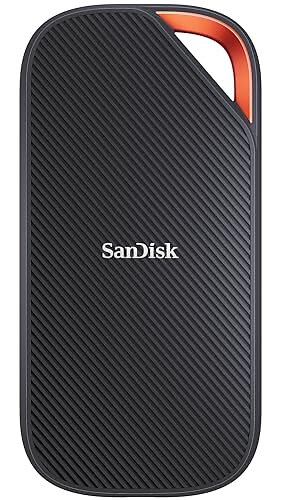
Image: SanDisk product render.
SanDisk Extreme PRO with USB4 4TB
Best value, and it is not closeThis is the drive that moved when we rechecked prices, and it changes the shape of the whole list. At £493.54 from Amazon UK, the Extreme PRO with USB4 is roughly £123 per terabyte. The LaCie Pro5 is £300. You are getting IP65 sealing, which covers water jets rather than splashes, and a drive that measured 3,172MB/s read and 2,864MB/s write in independent testing, for less than half the cost per terabyte of the drive above it.
The one place it gives ground is impact. SanDisk rates the USB4 model for drops of up to 2 metres, where the two LaCie drives and the T7 Shield all claim 3, and there is no published crush rating. Two metres covers a fall from a standing hand and not much more. It does work with PS5 and Xbox Series consoles, which none of the LaCie drives claim.
The trade is bulk. At 140mm long and 172g this is the biggest and heaviest drive on this page, closer to a paperback than something you clip to a strap. In a camera bag that is fine. In a jacket pocket it is not. Prices here are volatile too: PriceSpy's three-month range for this drive runs from £479 to £1,164, and the trend is currently falling, so check before you commit. Currys stock it too if you want a high street returns policy.
Worth knowing before you buy. SanDisk's earlier Extreme and Extreme PRO V2 drives, sold from 2023, had a well documented sudden data loss problem that produced multiple class action lawsuits against Western Digital and an independent hardware analysis pointing at solder joints rather than firmware. This USB4 model is a different product on a different controller and is not implicated in that. It is still a fair thing to weigh when the whole point of the purchase is trusting a drive with irreplaceable work, and it is the reason this drive does not take the top spot despite winning on value.
Pros
- Roughly £123 per terabyte, less than half the LaCie Pro5
- IP65 sealing combined with genuine USB4 speed
- Over 3.1GB/s measured read in independent testing
- Works with PlayStation 5 and Xbox Series consoles
Cons
- Biggest and heaviest drive here at 140mm and 172g
- 2 metre drop rating, a metre less than its rivals
- The earlier Extreme V2 generation's failure record
Compare live UK prices → From £493.54 at Amazon UK
3. LaCie Rugged SSD4 4TB
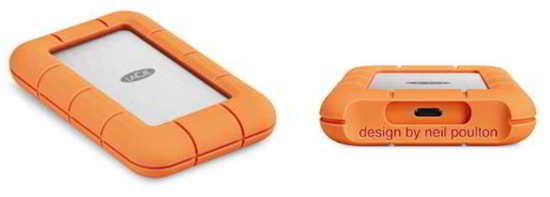
Image: Seagate. From the LaCie Rugged SSD4 press release.
LaCie Rugged SSD4 4TB
Fastest drive with a bumper on itThe Rugged SSD4 is the fastest sealed drive anyone has put on a test bench this year. StorageReview measured 3,183MB/s read and 3,185MB/s write, the only drive in their field to clear 3.1GB/s in both directions, and Tom's Hardware recorded around 4,000MB/s read and 3,700MB/s write on Windows 11. It gets there over USB4, which means it also works properly on Thunderbolt and older USB ports instead of falling over.
Physically it is the sweet spot of this group: 109g, palm-sized, wrapped in the orange silicone LaCie has used for two decades, rated for a 3 metre drop and one tonne of pressure. It also records ProRes 4K120 straight off an iPhone, which is a real use case now rather than a spec sheet line.
The compromise is the second digit. IP54 covers dust ingress that will not affect operation, and splashing water. It does not cover jets, and it certainly does not cover submersion. The other compromise is finding a sane price: Wex have it at £759 on pre-order and Scan want £3,211.49 for the identical part number. Buy it at £759 and it is excellent. Buy it at Scan's price and you have been robbed.
Pros
- Fastest measured sealed drive here, over 3.1GB/s both ways
- USB4 falls back cleanly to Thunderbolt and older USB
- 3 metre drop and one-tonne pressure resistance at 109g
- Records ProRes 4K120 directly from an iPhone
Cons
- IP54 is splash resistance only, the weakest sealing here
- UK pricing spans £759 to £3,211.49 for the same part
- Three-year warranty rather than five
See it at Wex Photo Video → £759 at Wex, £1,029 at ProAV
4. Samsung T7 Shield 4TB

Image: Samsung, from the T7 Shield press release.
Samsung T7 Shield 4TB
Most proven, easiest to buyThe T7 Shield has been on sale since late 2022 and it is still the rugged drive most working photographers actually own. IP65 sealing, a 3 metre drop rating and a grippy elastomer shell over an aluminium body add up to something that feels drop-proof in the hand rather than just on the spec sheet, and four years of field use have not turned up a systemic problem with it. It is also stocked by nine UK retailers, more than anything else here.
It is the only drive in this guide that needs nothing special from your laptop. USB 3.2 Gen 2 works at full speed on any USB-C port, on any Mac, on any PC, without a conversation about which port supports what.
The cost of that simplicity is speed, and this year, value. Measured at 894MB/s read and 937MB/s write on the 4TB model, it is about a quarter as fast as the USB4 drives above it. And at £636.99 from OnBuy or £691.53 from Amazon UK, it now costs £159 per terabyte against the SanDisk's £123. You are paying more for a drive that is three times slower. The one consolation is that PriceSpy has the trend falling, from a three-month high of £636.99, so this may be a temporary state of affairs.
Pros
- IP65 sealing and a 3 metre drop rating in a 98g body
- Four years of field history with no systemic failure pattern
- Stocked by nine UK retailers, the widest availability here
- Full speed on any USB-C host, no Thunderbolt required
Cons
- Around 900MB/s, a quarter of the USB4 drives
- £159 per TB against the faster SanDisk's £123
- Not suitable as a scratch disk for high-bitrate timelines
Compare live UK prices → From £636.99 at OnBuy
5. Samsung Portable SSD P9 4TB

Image: Samsung, from the P Series press release.
Samsung Portable SSD P9 4TB
Fastest here, thinnest rugged caseThe P9 is the newest and fastest drive in this guide by a wide margin. Samsung rates it at 4,000MB/s read and 3,800MB/s write over USB4, roughly double the outgoing T9, and says its sustained write performance is good enough for 12K direct recording. That last claim is the one that matters for filmmakers, because plenty of drives post fast opening numbers and then collapse when the cache fills. It won a CES 2026 Innovation Award and it is the world's first 8TB USB4 portable SSD at that speed.
So why is it last? Because this is a ruggedness ranking. Samsung's press material publishes 2 metre drop testing and shock and vibration testing for the P Series enclosure, and no IP rating whatsoever. There is no stated dust protection and no stated water protection. The body is angular metal with rounded edges and no bumper, described by one reviewer as durable without the traditional rugged look, which is an accurate way of putting it.
The price comparison is the uncomfortable part. UK RRP for the 4TB P9 is £1,184.49, against £1,199 for the IP68-rated LaCie Pro5. For the same money you can have the fastest drive here or the toughest one, and only one of them tells you what happens when it rains. If you want the sensible sibling, the P7 shares the interface, the enclosure and the drop rating at £986.99 for 4TB, and we broke both drives down in our Samsung P9 and P7 pricing analysis.
Pros
- Fastest rated drive here at 4,000MB/s read, 3,800MB/s write
- Sustained writes rated for 12K direct recording
- Compact 98g body, AES-256 encryption, five-year warranty
Cons
- No published IP rating, so no dust or water specification
- 2 metre drop test rather than the 3 metres rivals claim
- Bare metal body with no bumper or elastomer shell
- Costs the same as the IP68-rated LaCie Pro5
£1,184.49 UK RRP. The P7 is £986.99
What an IP Rating Actually Buys You
The two digits are separate specifications and most marketing copy blurs them. The first is solids, the second is liquids, and a drive can be excellent at one and mediocre at the other.
| Rating | Dust | Water | Real world |
|---|---|---|---|
| IP54 | Limited ingress, no effect on operation | Splashing from any direction | Rain, a spilled drink, a dusty bag |
| IP65 | Fully dust-tight | Low pressure jets from any direction | Sand, a hosing down, a genuinely wet day |
| IP68 | Fully dust-tight | Submersion, depth and time set by the maker | Dropped in a river and retrieved |
| None | Not specified | Not specified | Treat it as an indoor drive |
IP68 is the one people over-read. It does not mean waterproof forever. The manufacturer sets the depth and duration, and for the Pro5 that is 1.5 metres for 30 minutes, which is a rescue rating rather than a diving rating. Drop ratings are a separate axis and usually sit at 2 or 3 metres. That gap is meaningful: 2 metres covers a fall from a standing hand, 3 metres covers a fall from a ladder, a truck bed or a scaffold. If a drive lists no IP rating at all, that is not a drive that failed a test. It means the manufacturer chose not to certify it, and you should plan accordingly.
The 2027 Question: Buy Now or Wait?
Two things are moving in opposite directions, which is what makes this awkward.
NAND supply is the bad news. Memory manufacturers redirected capacity toward AI data centres from late 2025 and consumer supply collapsed behind it. Gartner does not forecast meaningful relief inside 2026, and SK hynix's chief executive said in July that 2027 would be the worst supply year in the industry's history. New fabs take years. Nobody serious expects portable SSD prices to return to 2023 levels before 2028.
Interfaces are the good news, and the SanDisk's current price is the proof. USB4 was exotic a year ago and is now on the Rugged SSD4, the Extreme PRO and both Samsung P Series drives. As it becomes the default through 2027, the drives currently commanding a flagship premium for having it will stop being special. PriceSpy already has both USB4 drives here on a falling trend while the older T7 Shield sits at its three-month high.
You need a rugged 4TB drive for a job in the next month
Buy the SanDiskAt £493.54 it is the only drive here that looks like fair value, and IP65 with a 3 metre drop rating covers almost every real field scenario short of submersion. Prices are not falling far enough this year to be worth waiting for.
You work somewhere the drive will actually get wet
Pay for the Pro5IP68 is the only rating on this page that survives immersion, and no amount of shopping around gets you that spec cheaper. Buy it at the Wex price, not the Scan price.
You want the fastest drive and can work around the conditions
Wait, or buy the P7The P9 premium is partly a USB4 premium, and through 2027 that stops being a differentiator. The P7 at £986.99 already gets you the same interface, the same enclosure and the same drop rating for £200 less.
You are buying storage for finished work rather than active projects
Do not buy an SSDRugged SSDs are for storage that moves. Archive storage sits still, and a hard drive gives you many times the capacity for the money. We covered the options in our budget external hard drive guide.
The Failure Mode a Rugged Shell Does Not Cover
Every drive on this page survives being dropped. None of them help with the thing that actually costs working photographers and filmmakers time, which is not knowing what is on which drive.
The pattern is familiar. Six or eight drives on a shelf, labelled with masking tape, each one holding some overlap with the others. A client asks for a file from a 2023 shoot. You plug in four drives to find it. You buy a fifth drive because you are out of space, when in reality two of the existing four contain the same 400GB of footage twice. At £123 per terabyte that duplicate is roughly £50 you did not need to spend.
DriveVault fixes the cataloguing rather than the storage. It scans each drive once and builds a permanent, searchable index of everything on it, so a shelf of drives behaves like a single library whether or not anything is plugged in. You can:
- Search every drive at once without plugging any of them in
- See image and video previews to confirm a file is the right one before you go and find the drive
- Compare two drives to verify a backup actually completed and spot duplicates before you buy more storage
- Tag, rate and organise across your entire archive, rugged drives and archive drives alike
DriveVault scans your first drive free and makes it searchable offline, forever.
Download DriveVault for MacFinal Recommendations
| If you want | Buy | Price | Score |
|---|---|---|---|
| The toughest 4TB drive money can buy | LaCie Rugged SSD Pro5 | £1,199 | 8.8 |
| The best drive for the money, full stop | SanDisk Extreme PRO USB4 | £493.54 | 8.3 |
| Maximum speed in a pocketable body | LaCie Rugged SSD4 | £759 | 8.2 |
| Proven sealing and no port compatibility questions | Samsung T7 Shield | £636.99 | 7.8 |
| Maximum sustained write for direct recording | Samsung P9, or the P7 to save £198 | £1,184.49 | 7.4 |
If you take one thing from this guide, make it the ordering. The most expensive drive here is not the best buy, the newest drive here is the least protected, and the cheapest drive on the page is the one we would put in most people's bags. Ruggedness is a specification you can read, not a finish you can look at, and the manufacturers who have done the certification say so in two digits on the box.
For a broader look at 4TB drives without the ruggedness filter, including hard drive options for archive work, see our 5 best 4TB external drives for creatives.